
Chronic Quadriceps Avoidance Following ACL Reconstruction and Microfracture
Case Study
Patient Profile
Demographics: 45-year-old male
Injury History: ACL rupture with chondral injury at age 22 (wakeboarding accident)
Surgical Intervention: ACL reconstruction with concomitant microfracture procedure to femoral head
Current Presentation: 23 years post-surgery with undiagnosed quadriceps avoidance gait
Clinical Presentation
Biomechanical Findings (Baseline Assessment)
Sagittal Knee Kinematics:
During baseline assessment, the subject demonstrated reduced knee flexion excursion during weight acceptance1 compared to normative. The patient's gait pattern shows a characteristic "stiffened-knee strategy" with minimal knee flexion during the loading response phase of gait, indicating chronic compensation patterns.
Quadriceps Electromyography (sEMG):
Surface EMG reveals near-absent quadriceps firing throughout the gait cycle. Individuals with anterior cruciate ligament deficiency typically do not have quadriceps activity during stance, an aberrant pattern termed "quadriceps avoidance" gait.2 In this case, the quadriceps avoidance persisted two decades after reconstruction.
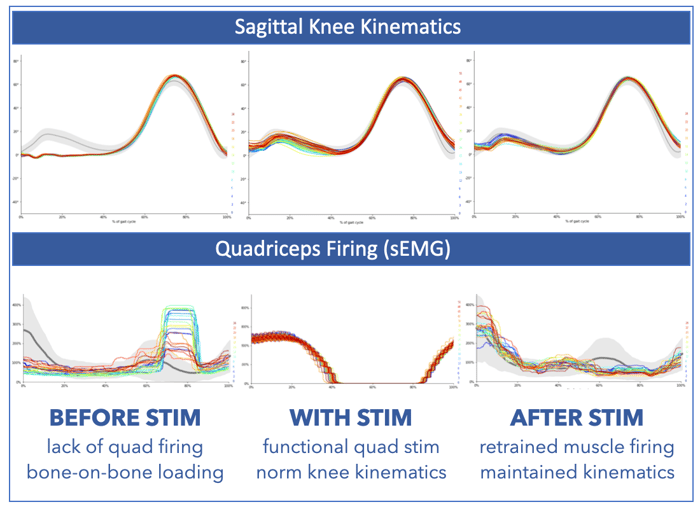
Figure 1: Sagittal knee kinematics and quadriceps firing of impacted leg.
Colored lines are each recorded stride,gray lines represent normative.
Physical Examination
- Visible atrophy of vastus medialis on impacted leg vs. un-impacted leg
- Altered gait mechanics with reduced knee flexion during stance
- Bone-on-bone loading pattern without muscular shock absorption
The Challenge: Post-Surgical Knee Rehabilitation
Quadriceps Dysfunction After ACL Reconstruction
Research demonstrates that biomechanical asymmetries during gait are highly prevalent, persistent, and linked to posttraumatic knee osteoarthritis1 following ACL reconstruction. Despite surgical repair, many patients fail to restore normal quadriceps function.
Participants may refrain from loading the joint in terminal extension due to on-going apprehension, a quadriceps strength deficit, or inadequate neuromuscular control.3 This case exemplifies how early post-operative neuromuscular deficits can become ingrained movement patterns lasting decades.
Why Traditional Rehabilitation Failed
Current rehabilitation is not addressing neuromuscular deficits underlying changes in gait mechanics.1 Even with criterion-based rehabilitation programs, studies show that individuals underwent 10 sessions of return-to-sports training, yet quadriceps strength symmetry does not modify gait mechanics.
Treatment Approach: Neuromuscular Electrical Stimulation
Intervention Protocol
Based on the biomechanical data presented, this patient underwent neuromuscular electrical stimulation (NMES) therapy targeting quadriceps re-education during functional activities.
Evidence for NMES
Recent systematic reviews demonstrate strong support for this intervention:
Postoperative rehabilitation with neuromuscular electrical stimulation after ACL surgery significantly increased quadriceps muscle strength compared with standard rehabilitation alone,4 with benefits observed in both short-term (≤6 weeks) and long-term (>6 weeks) follow-up periods.
Early use of neuromuscular electrical stimulation following the index injury and post surgery mitigates skeletal muscle atrophy and contractile dysfunction5 at the cellular level, preserving muscle fiber size and contractility.
Shortcomings of Traditional NMES
While NMES has demonstrated effectiveness in improving quadriceps strength, traditional protocols have significant limitations. Most NMES applications focus on muscle strengthening during static, non-functional positions—typically with the patient sitting and the knee in a fixed position during isometric contractions. The primary outcome of NMES treatment is to restore and improve quadriceps function,7 yet this approach fails to address the critical timing and coordination deficits that characterize quadriceps avoidance gait.
The fundamental problem is that strength gained in static positions does not automatically transfer to functional movement patterns. Patients may achieve improved quadriceps strength on a dynamometer yet continue to demonstrate aberrant gait mechanics during walking. This disconnect highlights a crucial gap in traditional rehabilitation approaches.
Advantages of Task-Specific Functional Electrical Stimulation
Functional electrical stimulation (FES) represents a paradigm shift by providing stimulation synchronized with actual gait patterns. The unique characteristics of FES, which provide stimulation in a coordinated, rhythmic pattern with the targeted movement, contribute to recovery of muscle control.6 Rather than strengthening muscles in isolation, FES retrains the neuromuscular system within the functional context of walking.
Key advantages of task-specific FES include:
- Motor Learning Integration: FES during gait incorporates motor learning principles, helping the nervous system relearn proper movement patterns rather than simply building strength
- Timing Precision: Stimulation is delivered at the exact moment during the gait cycle when quadriceps activation should occur, restoring proper neuromuscular timing
- Neuroplasticity: FES has been shown to improve voluntary muscle control and facilitate a therapeutic effect, which suggests positive neuroplastic changes8
- Functional Context: Training occurs during the actual task (walking), ensuring direct transfer of improvements to real-world function
- Gait Normalization: FES facilitates a more natural gait pattern, provides muscle activation, and reduces the occurrence of muscle atrophy8
Comparative research demonstrates the superiority of this approach. In a randomized controlled trial, subjects in the FES group regained 82% of their pre-quadriceps strength compared to 47% in the NMES group at 4 weeks post-surgery, with significantly better inter-limb strength symmetry.9 More importantly, FES directly addresses the movement pattern dysfunction that traditional NMES cannot resolve.
By stimulating the quadriceps during the loading response phase of gait—precisely when quadriceps avoidance occurs—FES "coaches" the neuromuscular system back to neurotypical patterns. This approach directly targets the root cause of persistent gait deviations: not simply muscle weakness, but dysfunctional motor control and timing.
Treatment Outcomes (From Biomechanical Data)
With Stimulation (Middle Column Figure 1):
- Functional quadriceps activation during stance phase
- Normalized knee kinematics approaching normative patterns
- Restoration of proper loading mechanics
After Stimulation (Right Column Figure 1):
- Retained muscle firing patterns without external stimulation
- Maintained knee kinematics
- Evidence of neuromuscular re-education and motor learning
The progression demonstrates successful reversal of a 23-year compensatory pattern through targeted neuromuscular re-education.
Clinical Implications
Long-Term Consequences of Untreated Quadriceps Avoidance
Multiple studies have shown gait deviations up to 8-12 months after knee surgeries such as ACL reconstruction, meniscectomy, and total knee replacement.10 This case demonstrates that without intervention, these patterns can persist for decades.
The biomechanical consequences include:
- Increased tibiofemoral joint loading
- Accelerated cartilage degeneration
- Development of posttraumatic osteoarthritis
- Persistent functional limitations
Rehabilitation Principles
- Early Detection: Routine gait analysis and EMG assessment should be standard in ACL rehabilitation
- Comprehensive Assessment: Screen for quadriceps avoidance beyond traditional strength testing
- Neuromuscular Focus: Functional electrical stimulation incorporates neuromuscular training with motor learning principles which optimize quadriceps strengthening6
- Functional Integration: Stimulation during actual movement patterns (walking, sit-to-stand) enhances motor learning
Conclusion
This case illustrates the profound and lasting impact of unaddressed neuromuscular deficits following ACL reconstruction. Despite being 23 years post-surgery, targeted neuromuscular electrical stimulation successfully restored quadriceps function and normalized gait mechanics.
The combination of ACL reconstruction and microfracture created a perfect storm for chronic dysfunction: surgical trauma, altered joint mechanics, progressive cartilage degeneration, and deeply ingrained compensatory movement patterns. Modern rehabilitation must address these neuromuscular deficits proactively to prevent long-term disability and osteoarthritis progression.
Key Takeaway: Strength alone is insufficient. Functional neuromuscular control must be directly addressed through specialized interventions like functional NMES combined with motor learning strategies.
References
-
Roewer BD, Capin JJ, Snyder-Mackler L, Di Stasi SL. Quadriceps Strength Symmetry Does Not Modify Gait Mechanics after ACL Reconstruction, Rehabilitation, and Return-to-Sport Training. PMC. 2021. Available from: https://pmc.ncbi.nlm.nih.gov/articles/PMC7863565/
-
Berchuck M, Andriacchi TP, Bach BR, Reider B. Return of normal gait patterns after anterior cruciate ligament reconstruction. Am J Sports Med. 1990;18(4):343-8. Available from: https://pubmed.ncbi.nlm.nih.gov/8291645/
-
Pfile K, Prosser B, Slone H, McLeod M, Gregory C, Hunnicutt J. Walking gait biomechanics in individuals with quadriceps tendon autograft anterior cruciate ligament reconstruction. Front Sports Act Living. 2025;7:1546297. Available from: https://www.frontiersin.org/journals/sports-and-active-living/articles/10.3389/fspor.2025.1546297/full
-
Jiang F, Xu Z, Xu X, Cui C, Wu H. Effects of Neuromuscular Electrical Stimulation on Quadriceps Femoris Muscle Strength and Knee Joint Function in Patients After ACL Surgery: A Systematic Review and Meta-analysis of Randomized Controlled Trials. Am J Sports Med. 2025. Available from: https://pmc.ncbi.nlm.nih.gov/articles/PMC11729445/
-
Lepley LK, Davi SM, Burland JP, Lepley AS. Utility of Neuromuscular Electrical Stimulation to Preserve Quadriceps Muscle Fiber Size and Contractility Following Anterior Cruciate Ligament Injury and Reconstruction: A Randomized, Sham-Controlled, Blinded Trial. Am J Sports Med. 2020. Available from: https://pmc.ncbi.nlm.nih.gov/articles/PMC7775613/
-
Moran U, Gottlieb U, Gam A, Springer S. Functional electrical stimulation following anterior cruciate ligament reconstruction: a randomized controlled pilot study. J NeuroEngineering Rehabil. 2019;16:89. Available from: https://jneuroengrehab.biomedcentral.com/articles/10.1186/s12984-019-0566-0
-
Kim KM, Croy T, Hertel J, Saliba S. Effects of Neuromuscular Electrical Stimulation After Anterior Cruciate Ligament Reconstruction on Quadriceps Strength, Function, and Patient-Oriented Outcomes: A Systematic Review. J Orthop Sports Phys Ther. 2010;40(7):383-91. Available from: https://www.jospt.org/doi/10.2519/jospt.2010.3184
-
Barrett CL, Mann GE, Taylor PN, Strike P. Effect of a 2-Week Trial of Functional Electrical Stimulation on Gait Function and Quality of Life in People with Multiple Sclerosis. Int J MS Care. 2014;16(3):146-52. Available from: https://pmc.ncbi.nlm.nih.gov/articles/PMC4204375/
-
Moran U, Gottlieb U, Springer S. Functional electrical stimulation following anterior cruciate ligament reconstruction: superior quadriceps strength recovery compared to NMES. J NeuroEngineering Rehabil. 2019. Available from: https://pubmed.ncbi.nlm.nih.gov/31299999/
-
Competitive Edge Physical Therapy. Quadriceps Avoidance: A Common Gait Deviation After Knee Surgery. 2023 Sep 6. Available from: https://compedgept.com/blog/quadriceps-avoidance-a-common-gait-deviation-after-knee-surgery/